
Upvora is customer-feedback, feature-voting and product-roadmap software you run yourself. A dark-first, modern take on the battle-tested Fider engine — with private team ideas, multiple products, a prioritization scorecard, and an optional AI ideation agent. One Docker image, your database, your data.
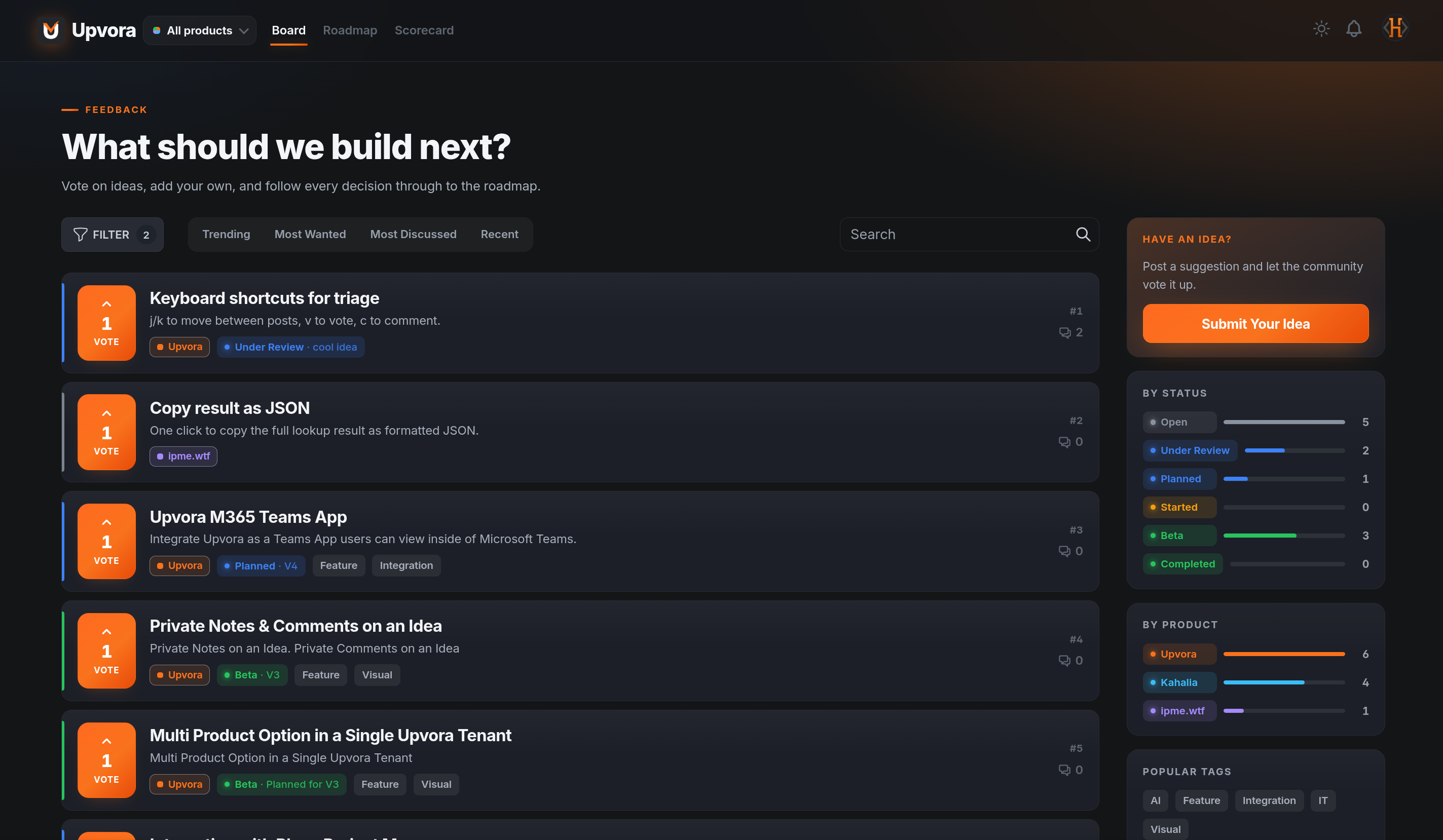
Dense, fast, dark-first board with one-click voting, optimistic UI, powerful sort tabs, full-text search with similar-idea detection, and rich-text + markdown comments.
Run every product from one place. Each gets a public board at /p/slug; every view filters to any combination of products with shareable URLs.
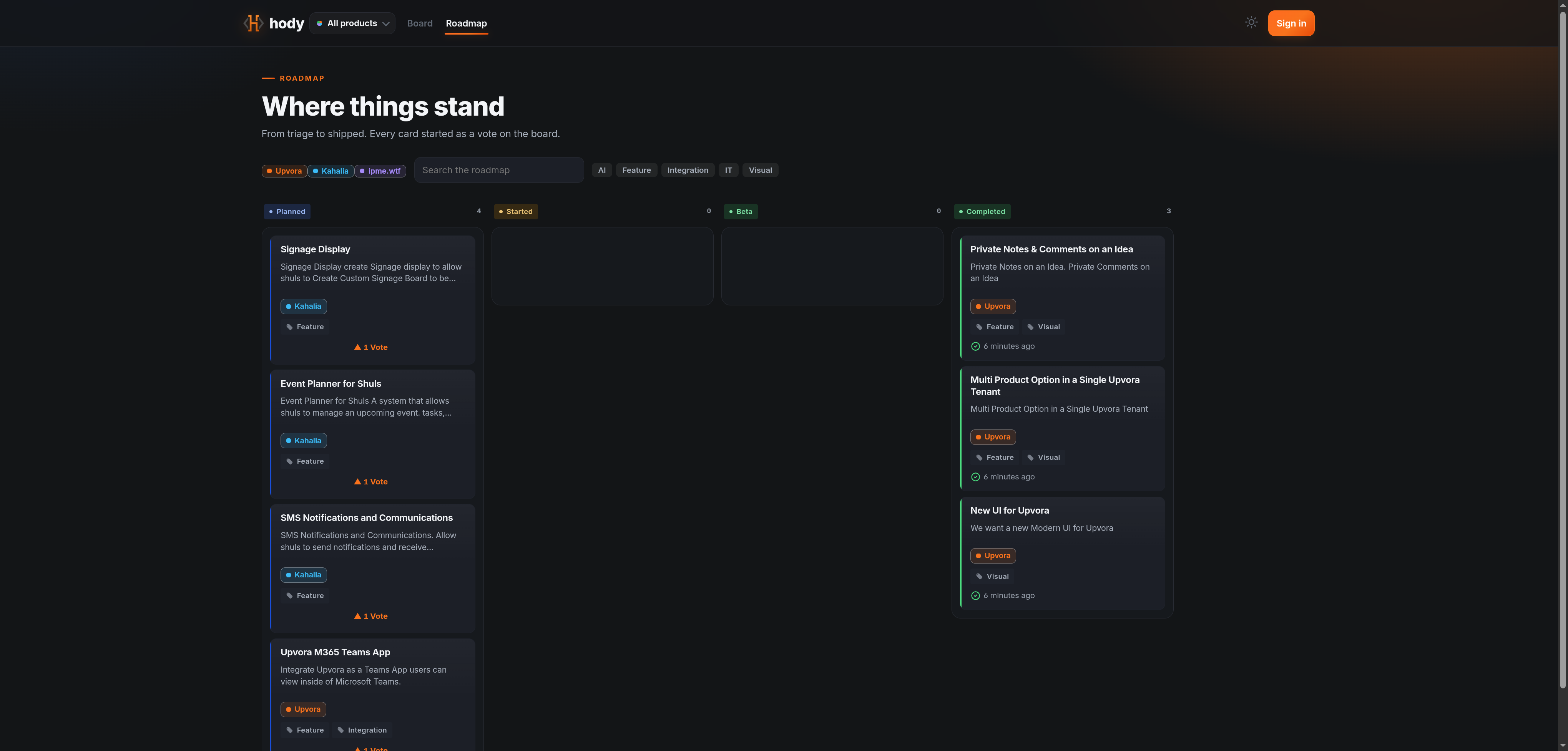
Status lanes with counts, filters, and inline voting — and your team can drag a card between lanes to restatus it. "What's planned?" becomes a URL, not a meeting.
A team-only scoring workspace: custom dimensions and form fields, weighted criteria, and a verdict read off an SVG progress ring with your thresholds.
Team onlyMark any idea private — at creation or with a one-click toggle — and it's hidden from everyone but collaborators on every surface: board, search, roadmap, RSS, API, counts, and notifications.
NewA deliberation layer visitors never see: collaborator-only comments excluded from public counts, plus one shared internal note per idea, live-synced with the scorecard.
Optional. Vora interviews the submitter and drafts a title, summary, tags, and a full Idea Brief. Bring your own provider — Anthropic, OpenAI, or a local LLM — with optional web search.
Optional · BYO keyYour brand color and per-function accents as design tokens across light and dark mode. Per-product colors and raw custom CSS still available for everything else.
A System panel shows your version against the latest release and — with the bundled updater sidecar — updates your instance from the browser. No SSH, no runbook.
Send transactional mail through SMTP, Mailgun, Amazon SES, or Resend — pick one with a single environment variable.
Passwordless email magic links out of the box, plus Google, GitHub, and any OAuth2/OIDC provider — Microsoft, Authentik, Keycloak, and more.
Webhooks, a REST API with per-user keys, CSV export, invitations, moderation, GDPR controls, 30+ languages, and migrations on boot. Kept current with upstream security releases.
Upvora is a friendly fork of Fider (AGPL-3.0). The engine — data model, API, auth, operational simplicity — is superb, so Upvora stays close enough to keep merging upstream improvements and security fixes.
| Capability | Fider | Upvora |
|---|---|---|
| Feedback board, voting, discussion | ✅ | ✅ redesigned — dark-first, dense, inline voting |
| Statuses | fixed set | ✅ fully custom (names, colors, home-page visibility) |
| Multiple products per portal | — | ✅ chips, filters, /p/slug public boards |
| Public roadmap | ✅ | ✅ lanes, filters, drag-to-restatus |
| Prioritization scorecard | — | ✅ custom dimensions, fields, weighted ring |
| Internal notes & team-only comments | — | ✅ |
| Private (team-only) ideas | — | ✅ hidden on every surface, one-click toggle |
| Theming | custom CSS | ✅ token-based color system + custom CSS |
| AI ideation agent (Vora) | — | ✅ optional; BYO provider incl. local LLMs, web search, Idea Briefs |
| Email delivery | SMTP · Mailgun · SES | ✅ + Resend |
| In-app updates | — | ✅ System panel + updater sidecar |
| Engine, API, SSO, i18n, webhooks | ✅ | ✅ inherited, kept current |
Want the smallest tool with the largest community? Use Fider — it's great. Want everything above out of the box, self-hosted? Welcome to Upvora.
Grab the compose file, set your URL and secrets, and bring it up. Migrations run on boot; put any TLS proxy in front (Traefik, Caddy, nginx, or a Cloudflare tunnel).
ghcr.io/hodyhq/upvoraAbout the fork. Upvora is an independent, open-source project built on getfider/fider and licensed under the same GNU AGPL-3.0. Original Fider copyright notices are retained. Upvora is not affiliated with, sponsored by, or endorsed by the Fider team — "Fider" is the name of that project and is referenced here only for comparison and attribution.
Upvora is self-host-only and fully open source. For bugs and feature requests, the GitHub issues are best — otherwise drop a note here.